Mathematics
Euclid
c. 325 BCE – c. 265 BCE · Greek (Alexandria)
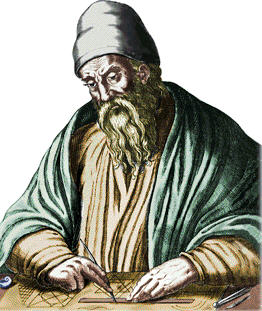
Euclid lived and worked in Alexandria, Egypt, during the reign of Ptolemy I. Almost nothing is known of his personal life, yet his thirteen-volume treatise — the Elements — is the most influential mathematical text ever written. It systematized all of Greek geometry into a rigorous axiomatic framework, starting from five postulates and deriving hundreds of theorems through pure logical deduction.
Why it matters
The Elements was used as the primary mathematics textbook in the Western world for over 2,000 years. It established the very notion of a mathematical proof and the axiomatic method that underpins all of modern mathematics. Without Euclid's framework, neither abstract algebra, topology, nor formal logic as we know them could have developed.
Key contributions
Euclidean Geometry
Systematized all known Greek geometry into five postulates; the first four are now standard axioms, and the fifth (the parallel postulate) generated non-Euclidean geometry when later mathematicians questioned it.
Euclidean Algorithm
The oldest known algorithm, used to compute the greatest common divisor of two integers — still the basis of modern modular arithmetic and RSA encryption.
Infinitude of Primes
Proved (Book IX, Proposition 20) that there are infinitely many prime numbers — one of the most elegant proofs in all of mathematics.
Number Theory Foundations
Books VII–IX of the Elements lay out the foundations of number theory: divisibility, GCD, prime factorization, and perfect numbers.
“The laws of nature are but the mathematical thoughts of God.”